
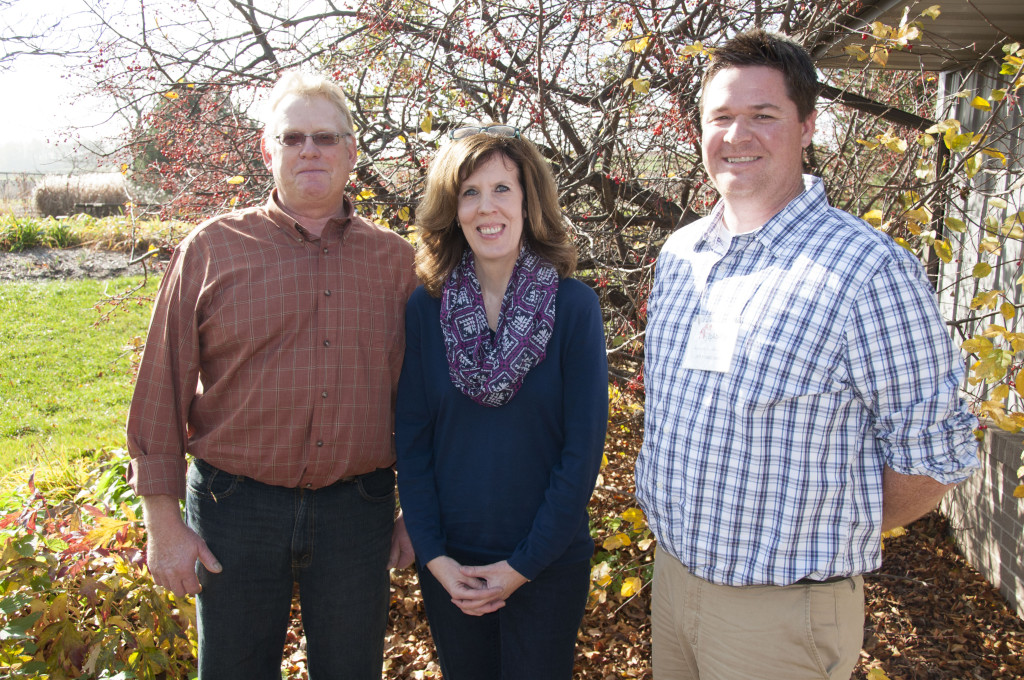
The Country Today– Jim Massey
MADISON — When Larry Wathke of Fall Creek slipped and fell 50 feet in his silo in December of 1993, he didn’t know if he would walk again, let alone be able to continue to operate his six-generation dairy farm.
But 22 years later, with the help of the AgrAbility of Wisconsin program, Wathke is carrying on his family’s tradition on his 320-acre Eau Claire County farm. He is milking about 60 cows in a tie-stall barn and the farm has been retrofitted with assistive modifications that have made it possible for him to continue in his chosen profession.
“What (the AgrAbility program) has done for me has made it a lot easier for me to continue to farm,” Wathke said Nov. 4 at the organization’s advisory council meeting in Madison. “We’ve been able to keep the family farm going. They came out to our farm, saw what I needed, and it has worked out well.”
 AgrAbility is a grant-funded program that is a partnership between Easter Seals Wisconsin and UW-Extension. The program provides services and adaptive equipment to farmers with injuries, disabilities or other limitations who want to continue farming and living independently.
When Wathke landed at the bottom of the silo after his 50-foot fall, he had significant injuries to his feet, ankles, back and internal organs. More than nine hours of surgery were required to insert more than 40 screws and several metal plates in his ankles, legs and feet.
Wathke spent 22 days in the hospital and didn’t walk for another three months after that. But about five months after the accident, he was back in the barn, milking cows again.
How did he do it?
“Willpower, I guess,” he said. “You’ve got to do what you’ve got to do.”
Wathke got along for more than 10 years without AgrAbility’s help, but he was struggling to get his work done. He had trouble walking over uneven terrain and standing for long periods of time while milking cows.
Jeff Kratochwill, an Easter Seals rural rehabilitation specialist, worked with Wathke to determine what changes needed to be made to allow him to keep farming.
Among the adaptations on the farm were a rail system that moved equipment from the barn to the milkhouse; a side entry door in a skid-steer so Wathke didn’t have to climb over the bucket to get in; alley mats to provide cushions over the concrete in the barn; and drive-through gates that open and close without the need to get on and off of a farm implement to get through.
His tractors and farm machines were also equipped with quick hitches to allow him to hook up equipment easier and a large-square-bale processor was added to grind up bales to make them easier to feed.
“These things should help me keep farming for years to come,” Wathke said.
About $50,000 was spent on the various improvements on the farm, Kratochwill said.
Wathke’s wife, Sheri, said it has been good to see her husband expend less energy when carrying out his farm work.
“It’s great this program is out there for the farmer that needs the extra help so they can stay farming,” she said. “He still comes in at night and he’s limping, and he’s not going to totally get rid of that. But it’s not as harsh on his body as what it was.”
The farm has been in Wathke’s family for 154 years, and his son, Mark, and Mark’s son represent the seventh and eighth generations on the farm.