
Local Veteran Finds Peace on Farm
Steve Acheson grew up on a dairy farm in Campbellsport, WI, and that’s where his passion for agriculture started. At the age of 18, he joined the Army and served 400 missions in Sadr City, Iraq in 2005. After serving, he earned a Civil/Structural engineering degree from UW Platteville, but he and his partner Steph wanted to do more.
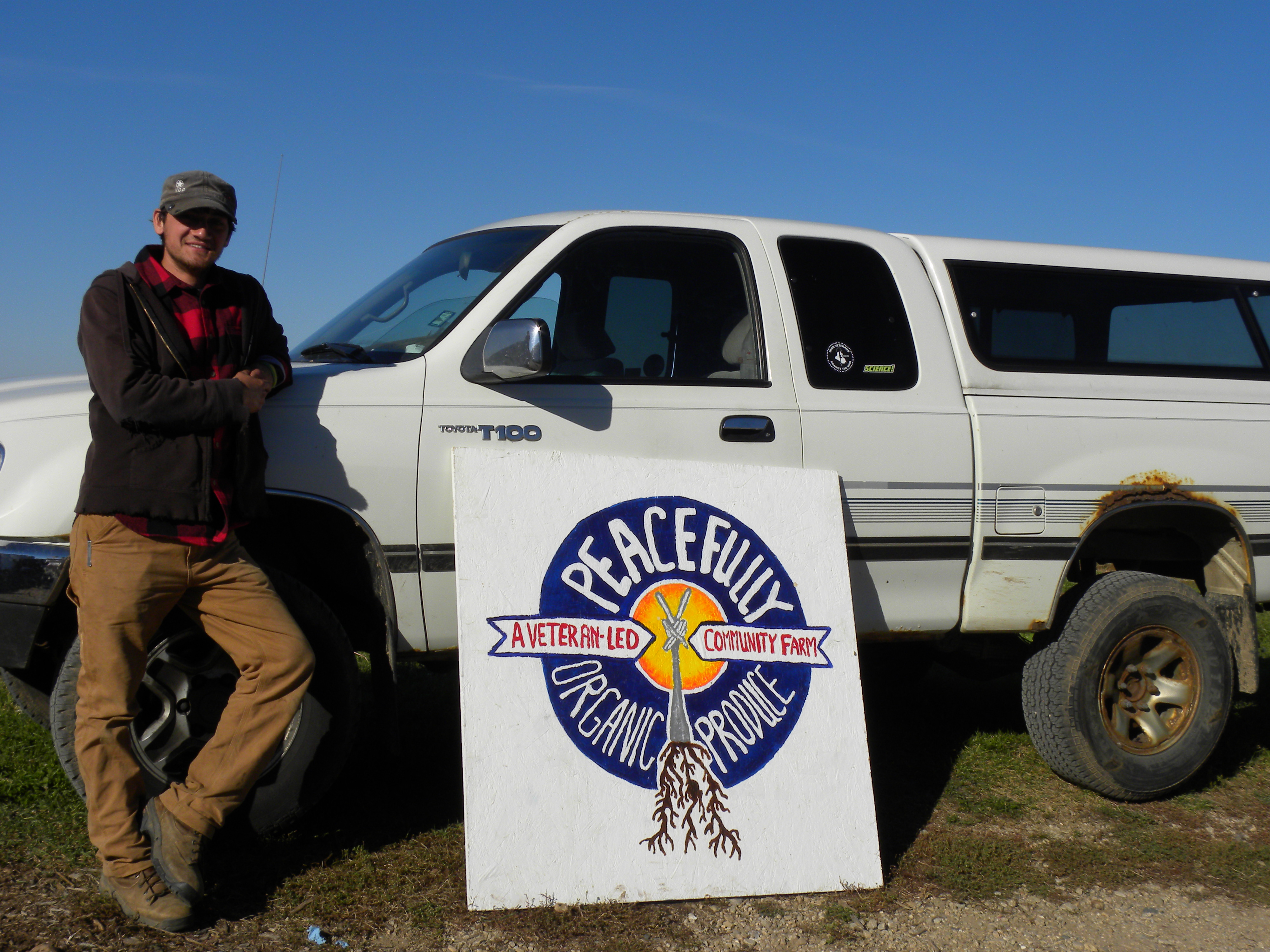 Steve and Steph started an organic community supported agriculture (CSA) farm a little over one year ago. A CSA is an alternative, locally based economic model of agriculture. It also can be referred to as a network of people who support local farms, with growers and consumers sharing the risks and benefits of food production. Peacefully Organic Produce is proud to be the first veteran-led CSA farms in the Madison area.
After just one year in the making, they gained 40 CSA members, and hope to get to 100 members by next year. Steve manages four acres of certified organic vegetables. He also has hives for honey, an herb garden, nine extra transitional acres for produce and crops, including melons, potatoes, onions, radishes, peppers, pumpkins, clover, squash, and carrots, just to name a few. Next year, he hopes to have egg-layers and a rotational poultry operation as well.
The majority of Steve’s workers are veterans, like himself. The farm aims to provide a peaceful place for veterans to return home and learn about organic agriculture. One of Steve’s goals is to educate veterans about CSA. “The biggest thing is to provide the veterans the ability to be productive with their time and hopefully come back from war and become a productive member in society,” said Steve. “Second is to help veterans heal and be part of something that is meaningful to the community.”
Steve’s future goal for the farm is not only growing his client base, but also reaching out to veterans. Some of the veterans are experiencing disabilities that prevent them from normal employment, and Peacefully Organic Produce helps them through Compensated Work Therapy – an entity of the Veteran’s Affairs (VA) that matches veterans to employers. Veterans will come out a few days a week to work, which is compensated either monetarily or by a weekly “worker’s share” of produce. Steve noted, “Over 70 percent of veterans from Wisconsin are from rural communities, so the farm is a good fit for them.”
Due to the heavy physical demands of organic farming, combined with service-connected disabilities, Steve is working with AgrAbility in hopes of making the work safer and easier not only for himself, but also for the other veterans on the farm. AgrAbility is looking forward to working with Steve and making connections with veterans.
For more information about Steve’s endeavors with Peacefully Organic Produce, visit http://popscsa.com.
New Website is in the Works
AgrAbility of Wisconsin announces it is renovating their website to offer clients, past, present and future, more resources and information about AgrAbility. The updated site, bse.wisc.edu/agrability, will feature all the previous newsletters, AgrAbility news, and testimonials from clients. With an easy-to-navigate website, AgrAbility hopes that users will be able to learn more about the program and AgrAbility’s mission to help farmers continue doing what they love.
Upcoming Events
- -Marshfield Farm Show-Marshfield Mall, Marshfield, WI, February 18-20
- – MOSES Organic Conference- La Crosse, WI, February 26-28
- -Eau Claire Farm Show- Eau Claire, WI, March 3-5 2015
- -Ag Women’s Summit breakout session- WI Dells, WI, March 13-14 2015
- -PDPW Business Conference- Madison, WI, March 18-19 2015
- -AgrAbility Summit- Marshfield, WI, March 16
- -WPS Farm Show- Oshkosh, WI, March 24-26 2015
AgrAbility Funding Renewed
AgrAbility of Wisconsin was recently awarded a grant of $180,000 per year from the United States Department of Agriculture. This new grant for the next four years was effective as of September 1. “I am pleased that we have been successful in our refunding proposal for Wisconsin AgrAbility,” said Richard Straub, Program Director for AgrAbility. “Our program now will have been continuously funded for 23 years. We are proud to be one of the most productive programs nationally, serving over 40% of all farmers served by projects across the country. We have tremendously talented and dedicated staff that makes this possible. I am proud of the service that we are able to provide to farmers with disabilities in order to help them maintain a productive life in a profession they love.”
AgrAbility of Wisconsin estimates that as many as 38,740 Wisconsin farmers are living with a disability. To date, AgrAbility has worked with nearly 2,500 farmers, successfully helping over 90 percent to continue farming.
For more information contact the office at (608)-262-9336 or email aaw@mailplus.wis.edu.
Growing New Farming Traditions
Protecting the next generation of farmers
After protecting farms across the state for over 80 years, Rural Mutual Insurance Company knows how important farming traditions are to Wisconsin. Rural Mutual also knows that protecting the families and children in our farming communities needs to be a priority in order to keep Wisconsin strong.
In the United States, farming and other agricultural professions consistently rank among the most dangerous, along with mining, transportation and construction. The difference, however, between agricultural professions and the other dangerous industries is the presence of children in the worksite. Farming is typically a family business, where children are raised on the farm and participate in farming activities beginning at young ages.
Troubling child safety statistics
- One child dies about every three days on a farm
- Of the leading sources of fatalities among all youth, 25% involved machinery, 17% involved motor vehicles (includes ATV’s), and 15% were drowning’s
- Every day, 38 kids are injured in an agricultural related accident
- It’s estimated that over 7,700 kids were hurt on a farm in 2012 and 80% of them were not working when the injury occurred
The good news is that the rate of injury among kids declined by over 60 percent from 1998 to 2002. But when you break the numbers down by age, you uncover another frightening statistic: injuries among kids under age 10 are increasing. From 2009 to 2012 the rate of injury among kids under age 10 almost doubled.
What does an injury cost?
- $143,580 for injury of a youth that required 10 or more days of hospitalization
- $6,577 for an injury requiring less than 10 days of hospitalization
- $4,293 in lost work for a hospitalization lasting 10 days or more
Bottom line, you cannot afford to NOT make safety a priority on your farm. For many, a single injury could wipe out a farms operating profit for an entire year.
So where do we go from here?
Rural Mutual knows that protecting the families and children in our farming communities needs to be a priority in order to keep Wisconsin strong and safe. To find more information on a variety of farm safety resources, if you are interested in sharing your own story, or you would like to request a safety seminar conducted on your farm, visit www.ruralins.com/farmsafety.
*Statistical information provided by the National Children’s Center for Rural and Agricultural Health & Safety
|
|
This material is based upon work supported by the Cooperative State Research, Education, and Extension Service, U.S. Department of Agriculture, under special project number 2014-41590-22330. UW-Extension provides equal opportunities in employment and programming including Title IX and ADA. If you need this material in another format, please contact AgrAbility of Wisconsin at (608) 262-9336. |
 Plowing Ahead