
Despite Obstacles, Determined Farmer Perseveres
Following an ATV accident in 1993, Clint Zank was given a two percent chance of survival. After 52 days in a coma and over 100 days in the hospital, he was told he would prob ably never walk again. Today, he runs Ridge Place Holsteins on 200 acres in Neillesville, Wisconsin.
Although he recovered from his accident, Clint was left with limited use of his left arm. When he started farming, he compensated by doing most of the heavy lifting with his right arm. With approximately 100 head of cattle and between 40-45 milk cows at any time, he began to notice the strain that the constant work was placing on his right arm.
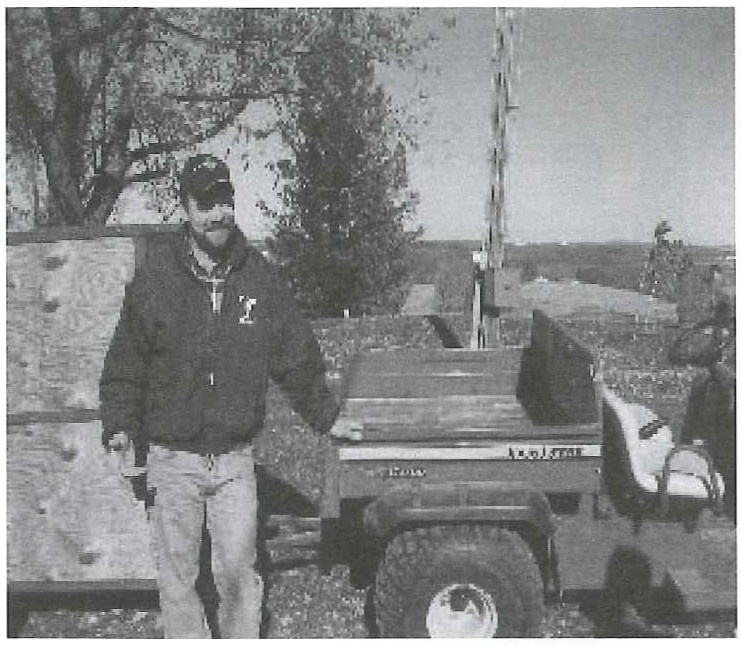 “It got to the point where I wasn’t sure how much longer I would be able to milk cows,” said Zank. This uncertainty lead him to con tact AgrAbility of Wisconsin to see what kinds of adjustments could be made to ensure that he could keep farming.,”I wasn’t quite sure what to think when we started the whole process. I just knew that my arm had been bothering me to the point where I couldn’t function like a normal person,” he explained.
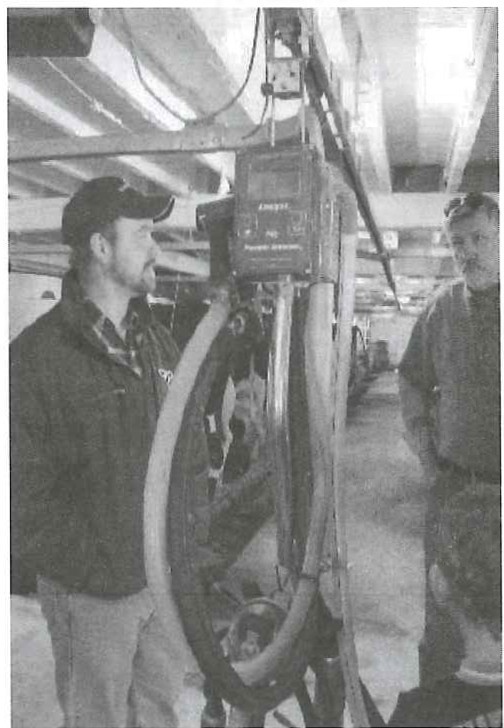
One of the main issues Zank had was hauling heavy equipment to and from the milk house twice daily. After consultations with AgrAbility of Wisconsin specialists, it was decided that an overhead track system would be installed in the barn. The system allows heavy equipment to glide along an over head track from the milk house to the individual stalls. Zank said, “I swore a lot the first time I used it, but the difference is like night and day. It really helps on my arms.”
Zank also had difficulties trans porting calves, milk, and calf feed across the farm. To assist with his efforts, he acquired a John Deere Gator Utility Vehicle and attachable calf cart. Zank said he was excited about the calf cart as “before we had to rope them out in the pasture and bring them in to the pen. Having the cart makes it a lot easier to haul them across the farm.” Zank also anticipated using his Gator during the winter months to help transporting salt and various tools.
 “It was a bit of a process going through the entire AgrAbility program, but I’m glad I did. It allowed me to keep doing what I love and to not have to give up,” stated Zank. His wife, Heidi, noted that “patience is key.”
According to Rural Rehabilitation Specialist Paul Untiet, Clint Zank is an example of the mission behind the FARM program. “Its all about functional limitations. Life changes and we need to adapt as it goes on.” With the adaptations made to his farm, Clint Zank hopes to continue farming for many years to come
Special Thanks to…Bob Meyer
For the past year, Bob Meyer has been acting as the Outreach Specialist for AgrAbility of Wisconsin at UW-Madison. In this position, he has been organizing client intake, maintaining client relationships, and increasing the visibility of the program through trade shows,outreach events, and various publications.
Thanks to his tireless efforts and unending support, AgrAbility of Wisconsin has had the opportunity to expand and reach many more clients.
Bob is moving on to a position as a Supported Employment Trainer for the State of Wisconsin. He will be working to provide technical support to pilot sites around the state that are implementing a mod el of supported employment known as Individual Placement and Support for individuals with severe mental illness.
We would like to take this opportunity to thank Bob for all he has done and his continued support as the program transitions under new leadership. His efforts are greatly appreciated and we will miss him dearly. We wish him nothing but the best in his new position.
AmeriCorps and Easter Seals: Working Together to Promote
Each year, Serve Wisconsin distributes grants allowing various non-profits throughout the state to hire AmeriCorps members to act in a service capacity. In exchange for their services, AmeriCorps members are awarded a living stipend, education award, and invaluable life experience. This year, Easter Seals has been fortunate enough to be able to hire four AmeriCorps members to serve with the FARM program.
Working with the UW-Extension half of the FARM program are Stacie Grady and Kimberly Wilke. Stacie is a 2010 graduate of the University of Wisconsin-Platteville with a degree in Dairy Science. She is acting as the Program Assistant and is assisting with client intake and database upkeep. Kimberly is a 2010 graduate of the University of Wisconsin-Madison with degrees in English and Theatre. She is the Marketing/Outreach Assistant and will be helping to create the newsletter as well as trade show displays and program outreach.
Working out of the Easter Seals office are Ryan Adams and Michael Goeldi. They both hold the title of Assistive Technology Assistants, helping the Easter Seals staff research and locate the assistive technology needed for various clients. Ryan is a 2010 graduate of the University of Wisconsin-Madison with a degree in Biochemistry. He is currently enrolled as a Doctor of Physical Therapy student at
UW-Madison with plans to graduate in 2013. Michael is a junior at the University of Wisconsin-Madison majoring in Genetics and Dairy Science.
All four AmeriCorps members are excited to contribute to the FARM program and serve the FARM clients in any capacity they can.
Resources for Farmers: Wisconsin Farm Center
One of the many resources available to farmers throughout the state is the Wisconsin Farm Center. The Farm Center is organized through the Department of Agriculture, Trade, and Consumer Protection. The Farm Center staff are trained to assist farmers in many capacities.
The Farm Center serves many functions.The staff are able to answer questions regarding farm transfers, mediation, financial counseling, and even provides resources for farmers looking to take up a different vocation.
The specialists at the Farm Center have a multitude of resources at their disposal to assist farmers with whatever issues arise. The staff comes from a broad agricultural background and have experience with all aspects of the farming trade and lifestyle.
The Farm Center is available to help via a toll-free hotline as well as drop-in counseling. They are available to take calls Monday through Friday from 7:45 am until 4:30pm., 1-800-942-2474. Farmers are also welcome to stop by the office, located at 2811 Agriculture Drive in Madison, anytime during those hours.
SAFETY FIRST…TOWING TIPS
Your equipment is stuck in the snow or mud and you need a tow. Before you slip on the old log chain, think about what needs to be done to safely move stuck equipment.
SELECT A PROPER TOWING DEVICE
Don’t grab the first rope or chain you find in the shop. The towing device will be put under a significant amount of tension. Soil condi tions and time or surface condition also need to be taken into account.
If the device or part of the device breaks, it can suddenly become a dangerous projectile. A long towing chain designed to support the tow load is recommended over nylon ropes or cables. Chains will break at their weakest point so check hooks and welds prior to towing.
For more information, visit www.fyi.uwex.edu/agsafety
ATTACH THE TOWING DEVICE PROPERLY
If using a tractor, it is important to attach the tow ing device to the drawbar. Improperly hitching to anything else increases the possibility of a rear overturn. Truck bumpers are not recommended as the pulling force may take off the bumper and transform it into a flying object.
More than one pulling vehicle may be required. In this case, attach each vehicle with a separate towing device.
CLEAR THE AREA OF BYSTANDERS INITIATE THE TOWING PROCESS
Double check all attachments to see that they are secure. If using more than one vehicle, coordinate efforts amongst all drivers. Apply power smoothly without jerking. At the first sign of danger, stop the towing process and re-evaluate.
|
|
This material is based upon work supported by the Cooperative State Research, Education, and Extension Service, U.S. Department of Agriculture, under special project number 2014-41590-22330. UW-Extension provides equal opportunities in employment and programming including Title IX and ADA. If you need this material in another format, please contact AgrAbility of Wisconsin at (608) 262-9336. |
 Plowing Ahead