
Successful Farming made Possible through AgrAbility
With just the turn of a key to the Kubota, comes the instant sound of excited cows throughout the yard. This Kubota is special in more than one way. First, it is used to feed many hungry cows and calves on this particular dairy farm. But for John Ederer, it is the sound of success when doing these simple farm chores. Walking a day in John Ederer’s shoes shows his dedication and passion of the family operation. With the assistance of AgrAbility, Ederer was able to continue what he knows best, farming.
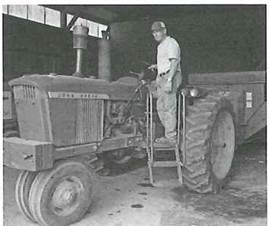 John Ederer and his two sons work 500 tillable acres and 300 acres of woods. Their crops include alfalfa, corn, and recently the addition of a few acres of soybeans. There are roughly 145 dairy cows almost all being registered, along with a few grazing steers. In addition to the tillable acres, Ederer and the two sons each live on separate farmsteads, milking roughly 70 cows. This summer, the family will be celebratinf the history of the farm; it is a century farm. The farm is set up as a partnership and is truly a family operation. In the future, Ederer hops to transfer the business to his sons.
AgrAbility came into the picture when Ederer had surgery. A blod-clot in his bloodstream resulted in amputating his right leg just below the knee, along with all the toes on his left foot except his little one.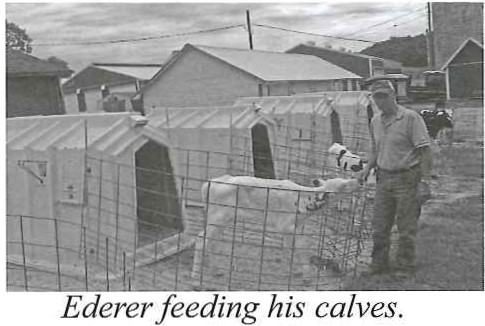
While Ederer was in the hospital, his insurance agent informed him of the program. His agent said he would enroll him if Ederer wasn’t going to do it himself. He said that there were times when he felt that he would be unable to go back to farming, but later he decided, “I wasn’t going to sit around.” Before long, Bruce Whitmore, one of the rural rehabilitation specialists from Easter Seals of Wisconsin FARM Program, came out to the farm to assess what would help Ederer stay in farming. One of Ederer’s main tasks on the farm is calf care. all calves are fed by pails and Ederer was having difficulty carrying the pails from the barn to the calves.
When Bruce came out to the farm, he suggest that a Kubota would help with this farm chore. Ederer said, about his service with Bruce, “He was a great guy to work with. The Kubota is great for carrying buckets. It saves time and there is less carrying done.”
AgrAbility worked with the Department of vocational Rehabilitation (DVR) to provide the accommodations needed for John. DVR supports employment and independent living for individuals with disabilities through services, training, and economic opportunities to maximize their employability, independence, and integration into the workplace and the community. Bruce said “Ederer is truly passionate about his farm operation. Over the years, John has developed a really nice farm operation. In talking with John, it was evident that he was very proud of the operation and the fact that he continues to work on the farm on a daily basis. The management of the two herds of dairy cattle is primarily done by his two sons, but John provides advice and support doing a number of tasks while his sons provide very close management of the livestock.”
In addition to the utility vehicle, John also received additional steps with hand rails for easier access to a few of the tractors. He said the additional steps have made it easier for him to do work with his tractor. He remembers when he did not have the additional steps and hand rails every time he gets on and off the tractors. Ederer has recently gone through the program again, because he was having difficulties maneuvering the foot controls when operating the bucket of the farm’s skid steer. Sometime in July he will be receiving his skid steer with hand controls so he can help with more of the day-to-day operations of the farm.
Not only is John pleased with the assistance he was given through AgrAbility; his family is too. John stated that his family, “thinks it’s pretty neat watching dad drive around with 20 pails in back of the Kubota, when they don’t have to do it!”
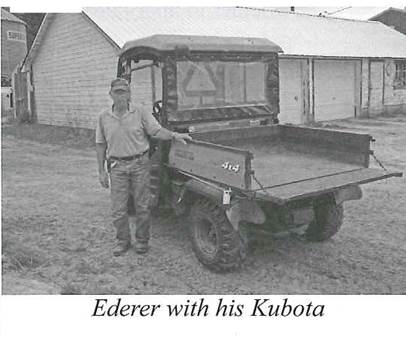
Today, you can find John still feeding his calves while driving around the Kubota provided by DVR. When asked “Why do you still continue to farm after all you have been through?” he simply replies, “I don’t know anything different. I enjoy it and working with animals and machinery. It’s always something different.”
~Kayla Wright
2013 Summit Success
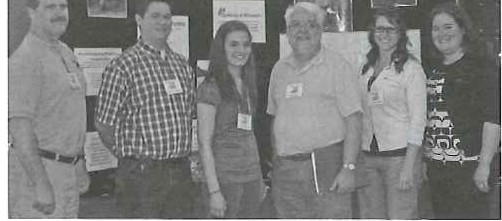
The second annual AgrAbility of Wisconsin Summit “Protecting your Assets beyond AgrAbility of Wisconsin” was held on May 16th in the Laird Center at the Marshfield Clinic.
The Summit had a variety of speakers and guests from various companies including: Shelly Mayer, Executive Director for Professional Dairy Producers of Wisconsin; Joy Kirkpatrick, Outreach Specialist for the UW Center for Diary Profitability; Marty Grosse, Economic Development Consultant from the Wisconsin Farm Center; Matthew Keifer, the Director of the National Farm Medicine Center; and Peggy Lutz, Pain Management Coordinator from the Ministry Saint Joseph’s Hospital.
Joy Kirkpatrick and Marty Grosse discussed financial hot topics within the Agriculture industry:
- Expecting the farm assets to be both business assets and retirement assets – can this be balanced?
- The risk or perceived risk of divorce on the farm business.
- The issue of inheritance – fair isn’t always equal.
- Asset protection from Medicaid Recovery.
Lunch was provided by the Marshfield Clinic and sponsored by Professional Dairy Producers of Wisconsin. Attendees were able to talk with the presenters and ask questions.
After lunch there were two more presentations. The first was by Matthew Keifer who talked about the National Farm Medicine Center; who they are and what they do. Some of the key things Matthew touched on were the common causes of injuries on farms, and services and resources they offer for farmers. The final presentation was by Peggy Lutz, who talked about how to manage chronic pain:, what medications are better to use for a specific pain and whether to apply heat or cold depending on where the pain is.
 If you are interested in learning more please contact AgrAbility of Wisconsin and we will be more than happy to get you connected. Please contact Vicki Janisch, Outreach Specialist at (608) 262-9336, or vjanisch@wisc.edu.
Come Check out AgrAbility of Wisconsin at Farm Technology Days
Wisconsin Farm Technology Days this year is at Breezy Hill Dairy in Dallas, WI of Barron County. This 485 dairy operation is owned by Alex and Mary Olson. All cattle are housed in ventilated freestall barns with sand bedding and all are on the home farm to maintain biosecurity. all crop land is used for corn silage, and haylage that is stored in drive over piles on blacktop.
Home Town Mobility electric scooters will be available on the grounds for those that request them. Reservations should be made through Home own Mobility and can be picked up at both the FFA Gate and Clover Gate during Farm Technology Days. They are available to rent for $35 per day. Electric scooter reservations need to be made 24 hours in advance and a driver’s license or state ID is required for all rentals.
For more information and to reserve an electric scooter or wagon for Farm Technology Days, call Home Town Mobility at 877-928-5388.
There is handicap parking available. One area will be right off 16th Street while e other is near County Highway A entrance. There will be signs posted to direct you where to park.
The AgrAbility of Wisconsin booth will be located in the progress pavilion on Central Avenue in the middle of tent city.
Dates and Times for Farm Tech Days:
– Tuesday, July 9th 9:00 AM- 5:00 PM
– Wednesday, July 10th 9:00 AM- 5:00 PM
– Thursday, July 11th 9:00 AM- 5:00 PM
The farm is located at :
146 16th Street, Dallas, WI 54733
Are you a Farmer or Rancher with an Arm or Leg Amputation?
Northwestern University Rehabilitation Engineering Research Center for Prosthetics and Orthotics is conducting research to learn how they can improve prostheses for farmers and ranchers. If you are a farmer or rancher with an upper- or lower-limb amputation, they would like to invite you to take a survey that asks questions about the type of prosthetic components you use and how well they perform in your farm or ranch work.
The online survey takes about 15 minutes to complete, depending on the information you provide. If you take the survey online, you will be anonymous, unless you choose to give your contact information. If you do not have computer access, please contact them for a printed copy, which requires that you provide your contact information for mailing and information about your amputation and prosthesis so they may match the survey to your situation. Surveys are tailored to meet each participant’s situation and include only relevant questions. Tailoring is done automatically in the online surveys and manually in print surveys.
“Assessing and Responding to the Prosthetic Needs of Farmers and Ranchers”, NU IRB #STU00006488 (funded by the National Institute on Disability and Rehabilitation Research (NIDRR), Grant H133E080009). Principal Investigator is Steven A. Gard, PhD, Department of Physical Medicine and Rehabilitation.
To request a printed survey or ask questions, contact Craig Heckathorne, MS:
- Email: c-heckathorne@northwestern.edu
- Phone: 312-503-5723
Learn more about this project here: http://www.nupoc.northwestem.edu/nupoc-research/other prosthetics_agworkers
In with the Intern
My name is Kayla Wright and I will be representing AgrAbility of Wisconsin this summer as the new Marketing & Communications Intern. I am the 21year old daughter of Mark and Linda Wright and older sister to Nicole. We reside in Jefferson County on a 300 acre, 200 head Registered Holstein dairy farm.
Currently, I am Senior at the University of Wisconsin River Falls majoring in Agricultural Marketing and Communications with a Minor in Dairy Science. The summer is already filling with events that I will be attending with AgrAbility. In a few weeks now I will be at Farm Technology Days in Dallas, WI to promote the program to farmers near and far. I look forward to reaching out to all of you during my time in the office. Until next time!
-Kayla Wright
|
|
This material is based upon work supported by the Cooperative State Research, Education, and Extension Service, U.S. Department of Agriculture, under special project number 2014-41590-22330. UW-Extension provides equal opportunities in employment and programming including Title IX and ADA. If you need this material in another format, please contact AgrAbility of Wisconsin at (608) 262-9336. |
 Plowing Ahead